

October 14, 2026
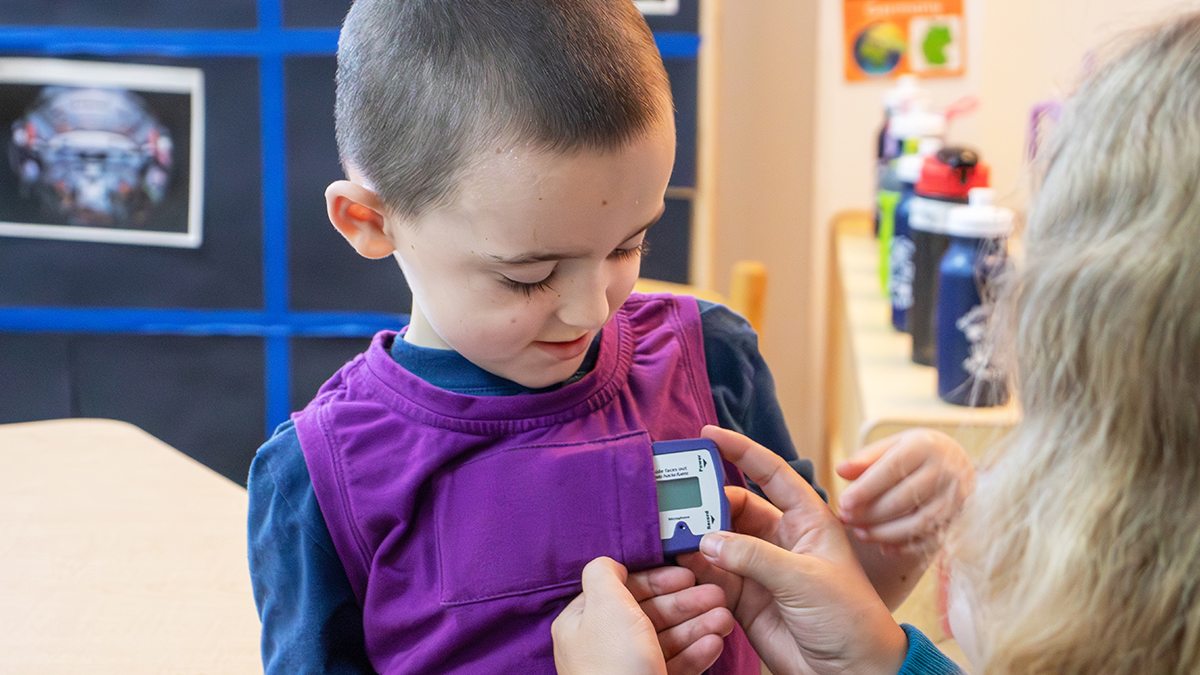
In Head Start classrooms across Nebraska, a small, cassette-shaped device tucked inside purple vests worn by young children is helping students and teachers build critical early language and literacy skills.
These "talk pedometers" use LENA Grow technology to measure conversational turns, the back-and-forth verbal interactions between babies, toddlers, and preschoolers and their caregivers—in this case, Nebraska Head Start teachers.
These exchanges are key to children’s brain development and early language formation, helping them learn new words and setting the stage for later reading success.
This innovative professional development and early literacy project is supported by a five-year, $1.295 million Comprehensive Literacy State Development (CLSD) grant from the U.S. Department of Education and Nebraska Department of Education.
With this funding, the Buffett Early Childhood Institute is partnering with the University of Nebraska at Kearney, the Nebraska Head Start Association, and seven Nebraska Head Start programs, impacting more than 1,300 children in urban and rural settings in the first two years of the grant. More programs may join in later years of the grant cycle.
"Strong language development, supported by warm, rich interactions with caregivers, is the foundation of literacy," said Alexandra Daro, the Buffett Institute's director of applied research and the principal investigator on the CLSD grant. "This grant allows us to invest in Head Start educators and the families they serve."
An additional nearly $100,000 University of Nebraska System Collaboration Initiative grant will allow researchers from the Institute, UNK, and University of Nebraska-Lincoln to conduct a deeper examination of data generated from the LENA Grow project.
Here's how it works:
- Over the course of five weeks, children, ages 0 to 5, wear the talk pedometers.
- The devices count the number of conversational turns, adult words, and child vocalizations. The conversations are not saved or stored.
- Educators work on different themes for different weeks, for example, talking more during diaper changes or mealtimes.
- Early educators assess language data from their own classrooms, receive tailored coaching, and learn new strategies to increase interactions.
Preliminary data from 15 classrooms is promising.
In center-based early childhood classrooms, LENA expects about 15 conversational turns per hour. Forty is optimal.
The first Nebraska classrooms started high, with an average of 35 conversational turns per hour. Through tracking and coaching, that increased to 45 turns per hour—a 28% increase in just five weeks.
The LENA data flags which children may need more support or intervention because they're receiving fewer interactions or hearing less talk. Those who started out in the lower third of conversational turns went from an average of 22 turns per hour to 36 turns, jumping 65%.
“What’s especially encouraging is that we’re seeing the largest gains among children who started out experiencing fewer conversational turns,” Daro said. “The goal isn’t simply to get adults to talk more. It’s to help educators use data to recognize which children may need more back-and-forth interaction and then give them practical strategies they can build into the routines they’re already doing every day.”
This summer, a Northeast Community Action Partnership Early Head Start classroom in Norfolk led by Gianna Caputo and Cassie Niedig participated in the program.
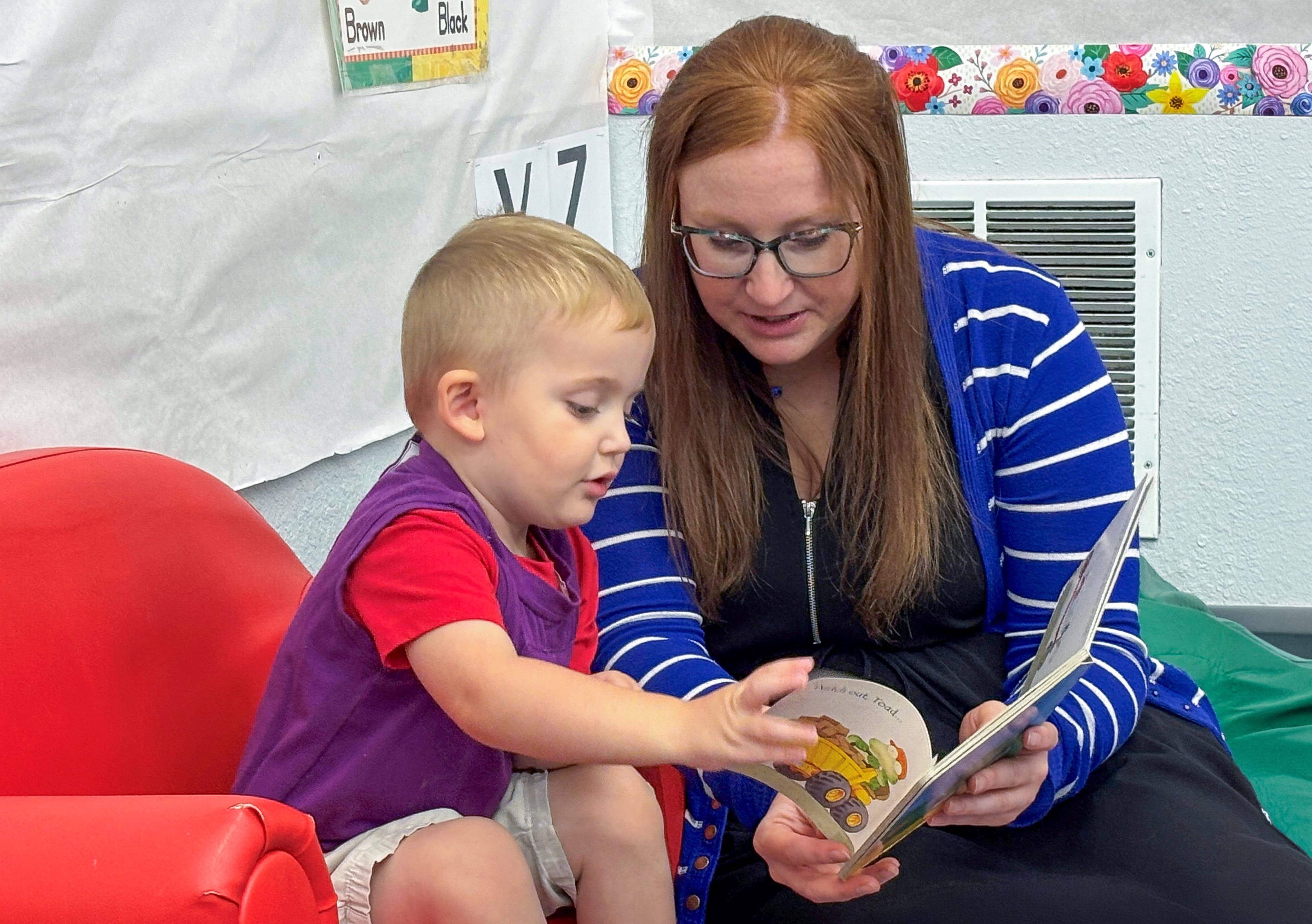 Amy Bloomquist reads in a Head Start classroom in Norfolk, Neb.
Once a week, on "LENA Day," the teachers would outfit their students in purple vests with the listening devices and wait to see what the data showed.
"We just let them talk and we collect the data," Niedig said.
The two had plenty to say as 2- and 3-year-olds scribbled with crayons, tussled over toys, and tugged on hands to get attention.
"Say please." "Let's share the zebra." "Use our walking feet."
But the data revealed surprises, too. Niedig didn't realize how much more she talked to one of the classroom's oldest and most-vocal children. Another child used gestures—waving, smiling—more than he actually talked. A toddler who is nonverbal made a lot of vocalizations, but teachers realized they weren't always responding directly to him.
"It's definitely helped us see which one of them talks the most, which one needs a little more talking to," Niedig said.
In Norfolk, families were largely curious and supportive of the project. They also received handouts with tips for talking more at home.
Mikki Rutar and Amy Bloomquist serve as coaches, helping teachers sift through the data and offering specific recommendations.
"The teachers have really liked looking at the data," Bloomquist said. "It's reinforcing the work they're doing."
Over the next year, the project will expand to at least 100 more classrooms, giving teachers more opportunities to build brains through the power of conversation.
Erin Duffy is the managing editor at the Buffett Early Childhood Institute at the University of Nebraska and writes about early childhood issues that affect children, families, educators, and communities. Previously, she spent more than a decade covering education stories and more for daily newspapers.