

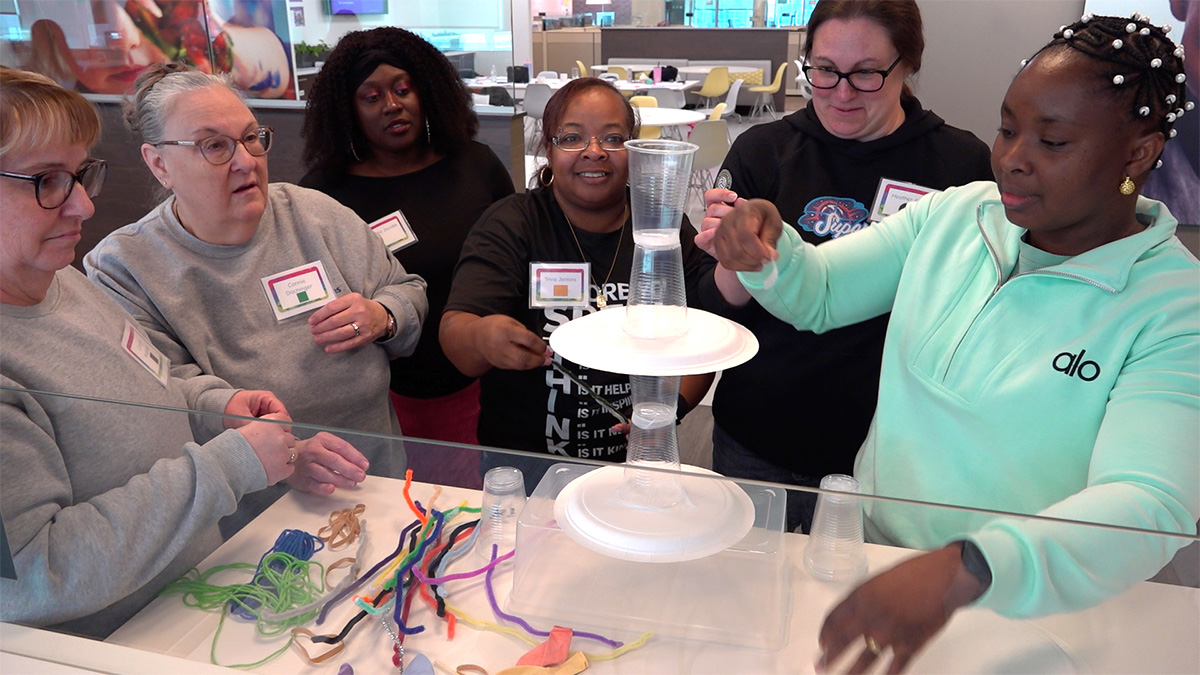
What is this child experiencing right now?
This simple but powerful question led Amy Schmidtke, director of educational practice at the Buffett Early Childhood Institute at the University of Nebraska, to name and refine what is now called the Lens of the Child: a way of seeing children's experiences more clearly and aligning teaching with how children actually experience learning.
"Over many years as an educator and as a coach for educators—from infant classrooms through the early elementary grades—I've seen how much intention teachers bring to their work," Schmidtke said. "The Lens of the Child grew from recognizing that even with that strong intention, it can sometimes be hard to see exactly how each child is experiencing a learning moment. This approach helps make those experiences more visible so teachers can respond with greater intention."
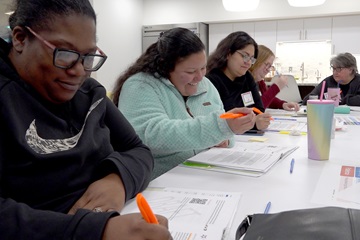 Early childhood educators participated in five, four-hour sessions
during the Lens series.
The Lens of the Child is not a curriculum or program. Instead, it is a way of seeing and being with children that helps educators align their teaching with how children actually experience learning. The Lens of the Child doesn't replace what educators already know. It helps them see more clearly what children are experiencing and respond with greater intention.
Thirty local educators experienced this through a recent cohort experience that concluded this month. Through this Early Learning through the Lens of the Child series, these early childhood educators participated in five, four-hour sessions, exploring how their environments, interactions, and learning opportunities shape those experiences for children from birth through Grade 3.
The approach provides a way to more clearly see which children are deeply engaged, which may need more challenge or support, and how learning opportunities can be strengthened In doing so, it helps ensure that all children have meaningful opportunities to engage, learn, and thrive.
The series is led by the Buffett Institute, in partnership with the Learning Community of Douglas and Sarpy Counties, as part of the Superintendents' Early Childhood Plan.
What makes the series unique compared to other professional learning opportunities is its strong integration of experiential learning with research-based practices.
"Many approaches in education focus on what teachers do—strategies, activities, or lesson structures," Schmidtke said. "Even when they are designed to be child-centered, educators are working to ensure those experiences are truly meaningful for each child. The Lens of the Child helps make that more visible, so teachers can respond with even greater intention."
The series focuses on the approach's foundational concepts and six essential child experiences—what children need to meaningfully engage, learn, and grow, and the conditions that ensure those experiences are actually happening. It blends core knowledge with practical strategies to help educators design meaningful, high-quality learning opportunities through immersive, hands-on learning.
"Educators shared that the series has changed the way they teach, the way they look at their classroom environments and learning activities, and the way they build relationships with children," said series facilitator Kimberlee Telford, an early childhood coordinator for the Buffett Institute who worked with a team to design the series. "Many described looking through the lens of the child as life-changing for both themselves and their students."
Rather than simply hearing about strategies, participants actively engage with the concepts. They reflect on them, and then they apply them in their real classroom settings with the children they serve. The series encourages educators to rethink their environments, their interactions, and their learning activities by asking what children are truly experiencing in those moments.
"I discovered that there is so much more nuance when working with young children that you don't necessarily learn from a classroom setting," said participant Robyn Helwig, an Early Head Start teacher in Sarpy County. "It was really awesome to see new perspectives and new philosophies and new ways of thinking about the same exact lessons that I've been teaching now for two years. But putting them through a different lens, through the lens of the young child, makes them more impactful and more meaningful."
"I think the benefit of having people there from birth to all the way third grade is that you get to see that continuum," said Tanishia Jacobs, Ed.D., a Bellevue Public Schools educator and facilitator for the series. "I really hope they got ideas from each other, and just that ability to network and to look at things in a different perspective."
Feedback from the series has been positive, with participants describing their experience as highly impactful.
Moving forward, Telford and Schmidtke plan to offer additional cohorts and expand participation to reach even more early childhood educators.
"When educators begin to consistently ask, ‘What is this child experiencing?', they gain powerful insight into how to support each child's growth, curiosity, and sense of belonging in the classroom, leading to lifelong learning and success, and helping the child be their best," Schmidtke said. "That's at the heart of what we're trying to do."
Greta Morris joined the Buffett Early Childhood Institute in June 2023. In her role as public outreach communications specialist, she is responsible for media relations, communications, and public outreach.