

Walking into a school isn't easy for every parent.
There's a maze of hallways and a sea of unfamiliar faces—the teacher, the bus driver, the principal.
There's the alphabet soup of educational acronyms: PBL (project-based learning). ELG (early learning guides). MTSS (multi-tiered systems of support).
And not every parent has positive memories of their own schooling.
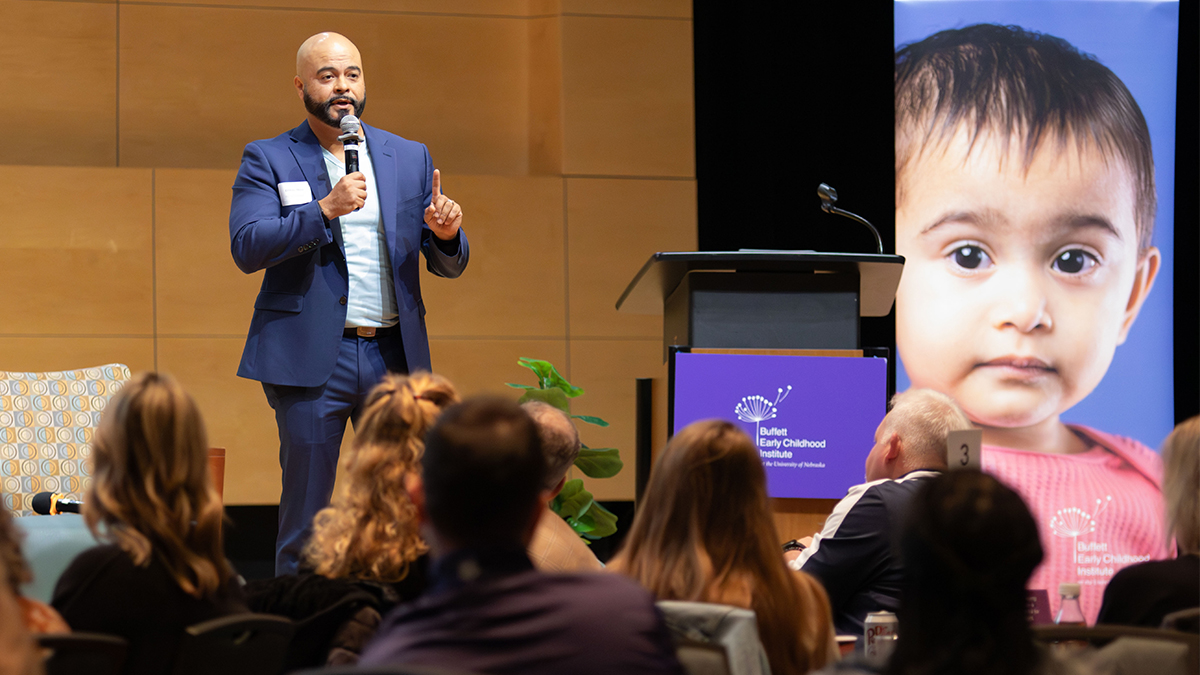
"It's intimidating. It's challenging. It's scary," said family engagement expert Ernesto Mejia, the keynote speaker at the fourth annual Superintendents' Early Childhood Plan convening on March 3 in Omaha. "Most families are not disengaged. They're disconnected from how schools work."
Forging deeper connections between schools and families was the focus of the convening, which was led by the Buffett Early Childhood Institute at the University of Nebraska.
"We know that families are the most important supporters, teachers, and guiders of their children's learning," said Amy Schmidtke, the Buffett Institute's director of educational practice. "Partnering with families is so very, very important. It's really where the magic happens."
Roughly 150 Omaha-area superintendents, district leaders, principals, school staff, community leaders, and members of the Learning Community of Douglas and Sarpy Counties Coordinating Council attended. Several principals and family engagement staff also participated in breakout sessions later in the morning.
The Superintendents' Plan is a collaborative initiative among 11 Omaha metro-area school districts to implement the School as Hub approach through aligned early childhood programming, professional learning, and customized technical assistance for each district. The Learning Community funds the work, and the Buffett Institute helps implement it.
Mejia outlined the differences between family involvement and family engagement.
Involvement may be a little more surface-level, such as busy parents attending a back-to-school night meeting.
Engagement goes deeper.
"I'm calling, texting, emailing, coming after hours, asking if there's anything I can do to help out, bringing in snacks," Mejia said. "We want to have both, the involvement and the engagement."
But parents may need help understanding the difference between the two, and schools can bridge the gap by providing concrete examples and opportunities for families to get more involved in their child's education.
Teachers preach the importance of early literacy, Mejia said, but families may not know how to maximize the benefits of a 10-minute bedtime story. Consider hosting a school event or filming a quick video showing parents some questions they can ask while reading to spark their child's imagination and build their vocabulary.
Children can thrive when schools and families build trusting relationships and work together to solve issues that arise, said Walter Gilliam, the Buffett Institute's executive director. He's spent years studying preschool suspensions and expulsions.
"I've never heard of a child who got expelled from a program when the parent and teacher knew and liked each other," he said.
Educators from Sandoz, Mount View, and Belleaire elementary schools participated in a panel discussion and shared their strategies for connecting with families.
All three schools use the School as Hub approach, which positions schools as central hubs that connect children and their families to quality learning experiences, supports, and community resources within and beyond school walls.
School as Hub sites have reduced chronic absenteeism to levels far below the rest of Douglas County schools and, for the last two years, to levels notably below Nebraska—without hiring a single truancy officer, Gilliam noted.
That's the power of school-family relationships.
At Belleaire Elementary in Bellevue, parents and teachers use the ClassDojo app to send announcements, reminders, and quick notes about sick kids, said Tanishia Jacobs, the school's Title 1 coordinator. The app can also be used as a translator—15% of Belleaire students are English learners.
"That language barrier is always an issue in our schools, and we're trying to demolish that using the app," Jacobs said.
At Mount View Elementary in North Omaha, Principal Joe Shimerdla said outreach goes beyond just families—school officials work with local child care providers, churches, and other community members to support students.
Home visitor Helen Evans said Millard's Sandoz Elementary has implemented a preschool readiness program so parents and children can be introduced to school staff and get familiar with the school building.
Itzeni Nayeli Lopez, the executive director of elementary learning centers at the Learning Community, highlighted the supportive relationships among the Buffett Institute, the Learning Community, and all 11 participating school districts. She emphasized that when any one district strengthens outcomes for children and families, the entire Learning Community benefits.
"If Bellevue flourishes, Omaha flourishes," she said. "Collaboration is the key word."
Erin Duffy is the managing editor at the Buffett Early Childhood Institute at the University of Nebraska and writes about early childhood issues that affect children, families, educators, and communities. Previously, she spent more than a decade covering education stories and more for daily newspapers.